
Turning strategy, culture, and leadership into one steady pulse
When a European technical services provider joined a decentralised European group, the leadership pool looked strong on paper. However, the numbers told a different story.
Financial results were erratic, forecasts unreliable, and the newly‑assembled Management Team struggled to act as one. Without a shared vision or roadmap for change, long-term thinking gave way to day‑to‑day firefighting.
Where things got stuck:
The leadership team knew that something had to change. But before jumping into solution-mode, they needed to pause and reflect. The first step wasn’t a bold new strategy or cultural overhaul, but a series of honest conversations.
Through deep-dive interviews and early alignment sessions, the team began surfacing unspoken tensions, different expectations, and clashing assumptions. It laid the groundwork for a shared understanding of how they truly worked together. Where trust was thin, where habits clashed, and what needed to shift to become a real team.
1. From names on the chart to one real team
We started with deep-dive interviews to hear everyone’s perspective. During a two-day off-site inspired by Lencioni’s team dynamics, we tackled the tough stuff: trust, roles, and how to truly show up as an ambitious top team.
Experience matters, but so does reflection. Stepping into a new team or context calls for dedicated time to grow as a leader. That’s why we invested in individual leadership growth, as well as team dynamics. Executive coaching created more clarity, confidence, and cohesion.
2. A united strategy
We co-created the strategy in a way that made sense for everyone. Each business unit had space to shape its own plan, while anchoring to one shared direction. To keep it sharp, we used a “5-minute pitch” format: one slide, one clear story. It made big ideas easy to share, challenge, and commit to. This created one unified roadmap, shaped by all, used by all. It also became a valuable moment for leaders to practise sharing the strategy with their own teams, making it easier to cascade later. More than just alignment, it helped everyone really live the strategy before rolling it out.
3. From strategy to impact
Once the shared strategy was in place, the next challenge was building a powerful management system. Together, we worked on identifying and prioritising internal projects: helping the team make clear choices and avoid doing everything at once.
At the same time, we focused on upgrading internal project management capabilities, so the team could execute effectively on the change initiatives in their business context.
4. Bringing culture to life
The Barrett Culture Values Assessment helped the team understand where their culture was energising the organisation, and where it was holding them back. We involved the entire organisation, giving everyone a voice in what needed to shift. From there, we translated those insights into concrete, day-to-day behaviours that teams could recognise and act on.
Momentum can fade fast without creating a rhythm. So, every 6 weeks, the leadership team came together to check in on progress, remove obstacles, and share wins. Regular townhalls and team sessions kept the rest of the organisation in the loop, and part of the entire transformation.
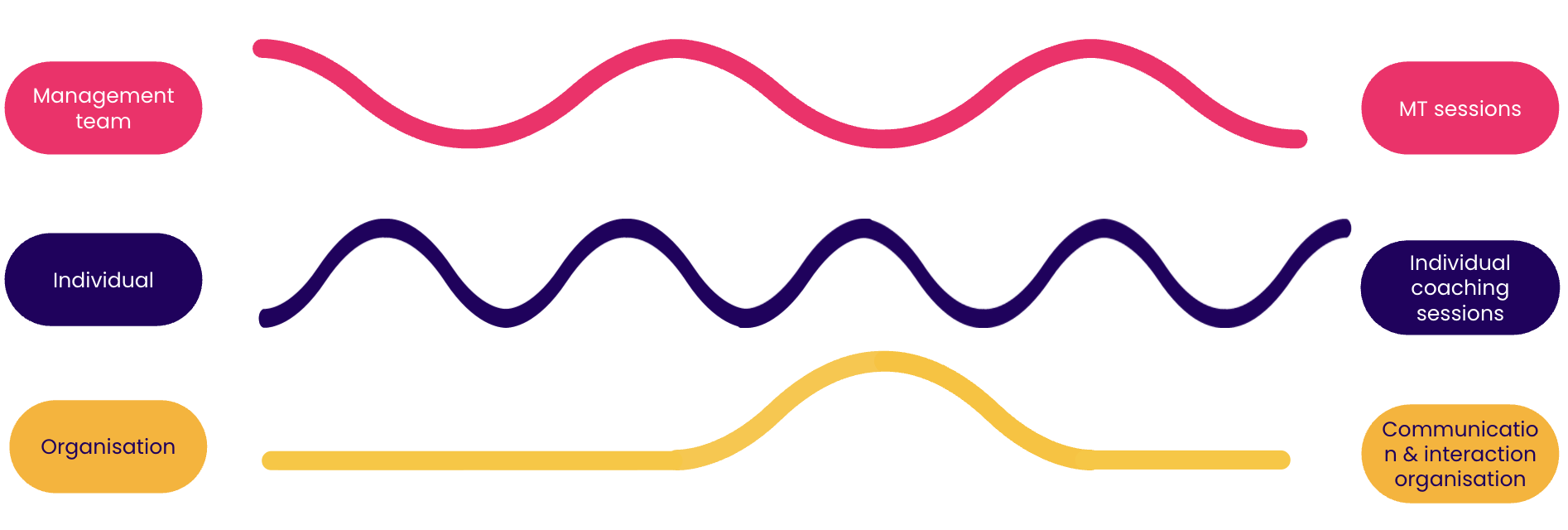
What made it work? We kept things simple and steady. Instead of grand plans, we focused on small steps with a steady rhythm: meeting weekly, making decisions together, and keeping momentum visible. And most importantly, we worked side by side with our client to charge their batteries.
As a result, the leadership team trusts and supports each other, financial results and predictability went up, strategy execution is aligned across all BU’s, and they’ve created the right energy to fix anything!
LQ team

Managing Partner

Business Transformation Manager
Business Transformation Manager