
Bringing a powerful strategy to life in daily operations
In this article, you’ll:
Wit-Gele Kruis Antwerpen is a public home care organisation, supporting people across Antwerp with essential nursing and daily care. After the organisation shaped a clear strategic ambition with Professor Kurt Verweire (Vlerick Business School), they faced an essential question:
How do we go from strategy to impact?
Because having a strong ambition is one thing. Translating it into clear choices, manageable priorities, and workable projects is something else entirely.
That’s where we came in.
We started with the 6 Batteries of Change scan, a deeper look at the energy behind the organisation’s ability to change. It reveals how strong each “battery” is, where energy is draining, and where bright spots can be leveraged to move the organisation forward.
“It’s a solid model, and LQ is exceptionally strong in applying it. They make a very good, honest analysis of where the real challenges sit within your organisation.”
It showed green lights across the board. Wit-Gele Kruis was performing at a high level, with strong alignment and engagement. But even the best athletes need coaching to win gold.
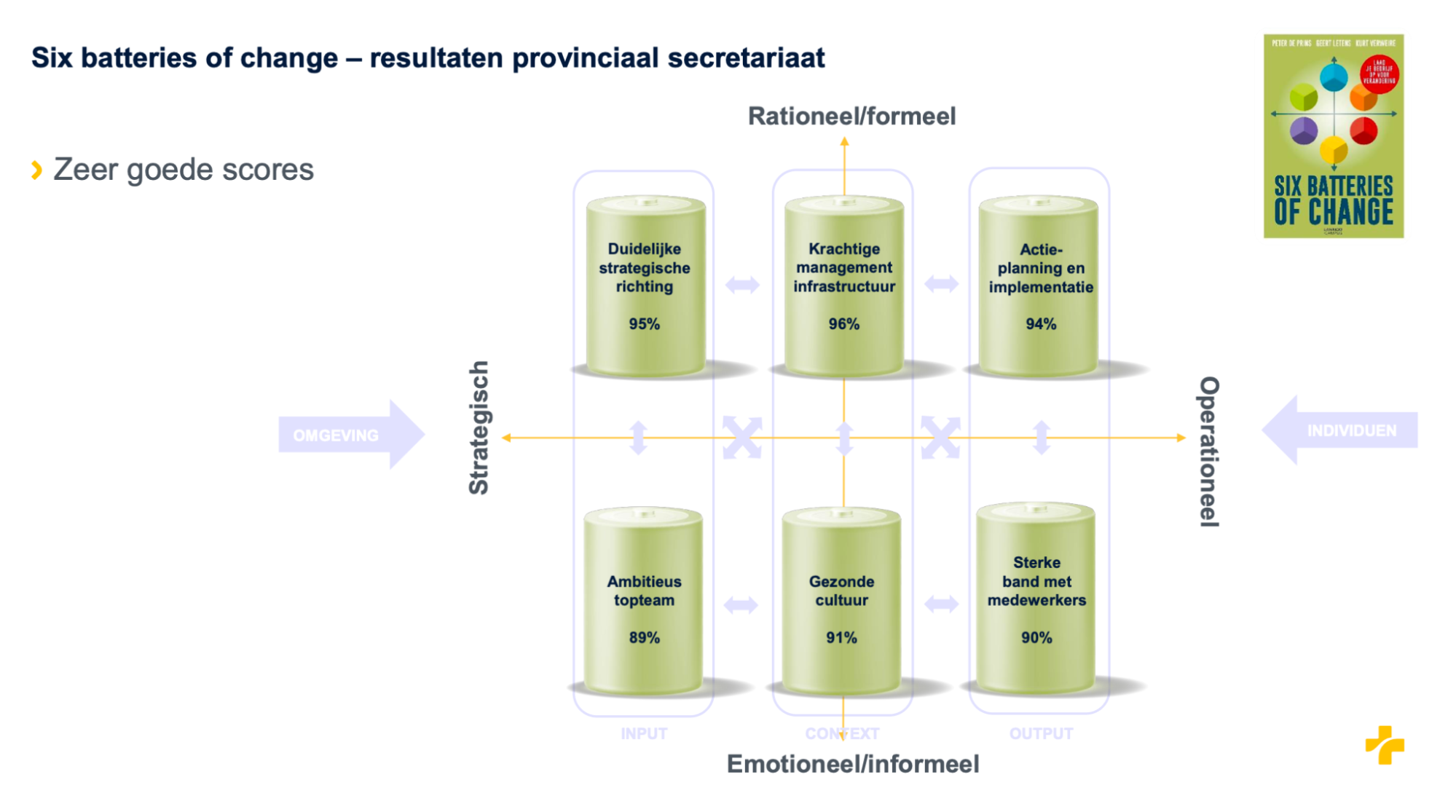
As one of our favourite metaphors goes: you’re not just a serious athlete, you want to be an Olympian.
The scan revealed key areas where focused improvements could lead to exponential gains:
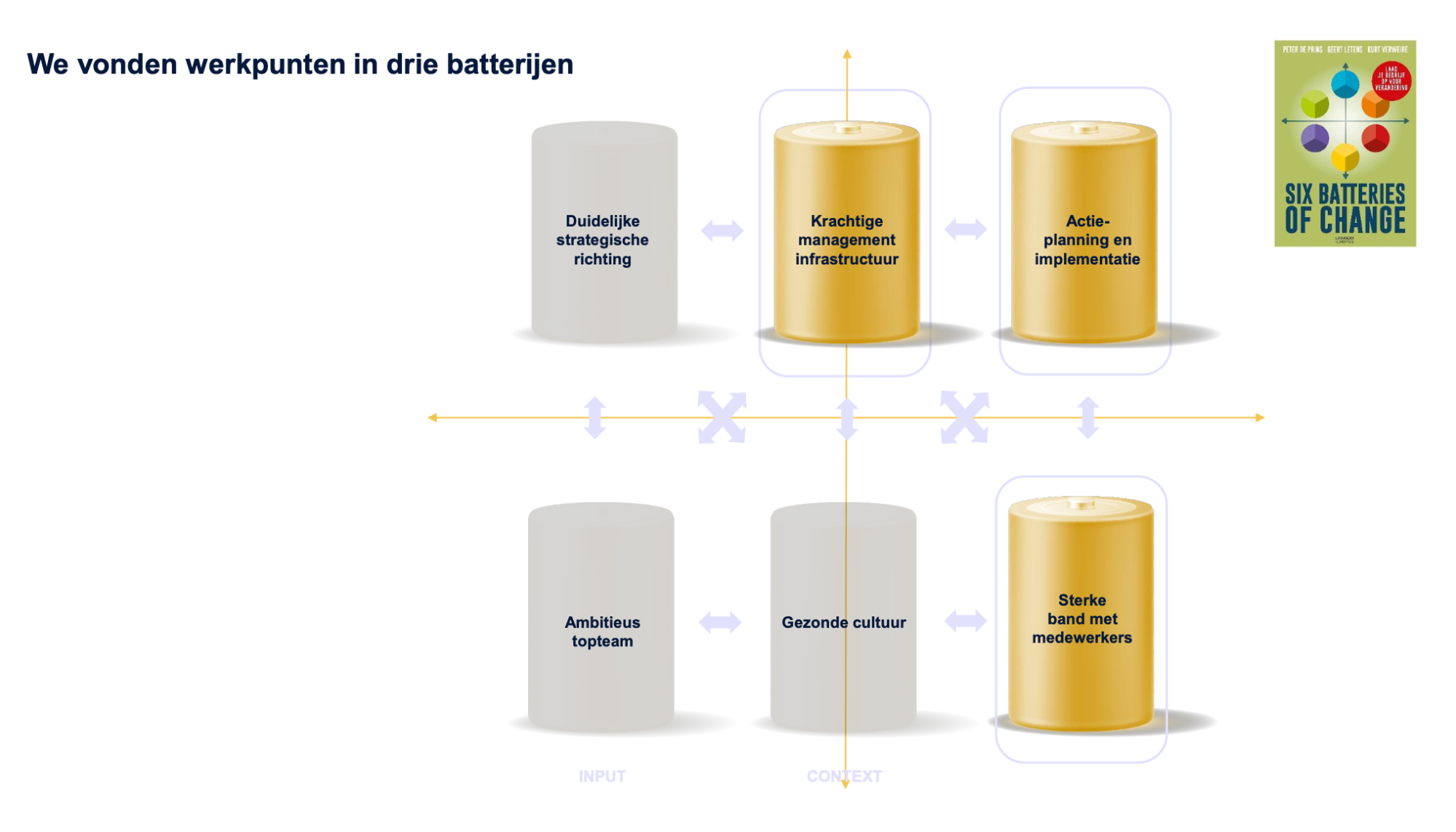
Wit-Gele Kruis discovered that their strong organisational engine was running too many races at once.
Departments and functions were enthusiastic and full of initiative, but that energy came at a price.
Too many projects were running in parallel, with limited cross-functional alignment and unclear communication about who was doing what, when, and through which channel. As a result, workloads overlapped, and the field teams often faced an overload of initiatives competing for attention.
A key bottleneck emerged in the organisation’s capacity at the frontline: the nursing teams. Their availability to contribute to projects was limited, making it difficult to balance operational demands with improvement efforts.
Within project execution, teams struggled to maintain realistic time horizons. Without a consistent methodology to guide them, they often jumped straight to solutions without fully understanding the problem or collecting data. Many projects began without a clear charter, root-cause analysis, or piloting in one department before scaling. As a result, planning became overly optimistic, execution uneven, and outcomes unpredictable.
One of the key takeaways for Wit-Gele Kruis was the need to involve employees more actively in change projects. On the work floor, engagement felt too distant; people didn’t always see how their voices or ideas connected to ongoing changes.
The goal became clear:
Encourage participation, foster transformation ownership, and make every employee feel part of the journey.
Turning strategy into impact meant creating focus, rhythm, and the right structure to make projects flow. Together with Wit-Gele Kruis, we tackled 4 core pillars that now form the backbone of their way of working.
When we looked at the original project charter from Wit-Gele Kruis, we saw a strong starting point. It just needed more focus and a clearer link to their bigger picture.
We refined the format to make it easier to use and clearer in purpose. Each charter now:
→ These updates turned the project charter from a formality into a real steering tool. One that gives structure, clarity, and focus at every stage of a project.
Once clarity was in place, it was time to focus.
Using the golf ball metaphor, inspired by the classic story of filling a jar with big and small stones, we helped the team identify their “big rocks”: the projects that would make the biggest difference in delivering on the organisation’s strategy.
Each project was assessed against the strategic objectives to see how much it contributed to the long-term vision.
We mapped out all projects into a visual prioritisation board. Categorising the projects as strategic (golfballs) tactical (pebbles) and operational (sand).
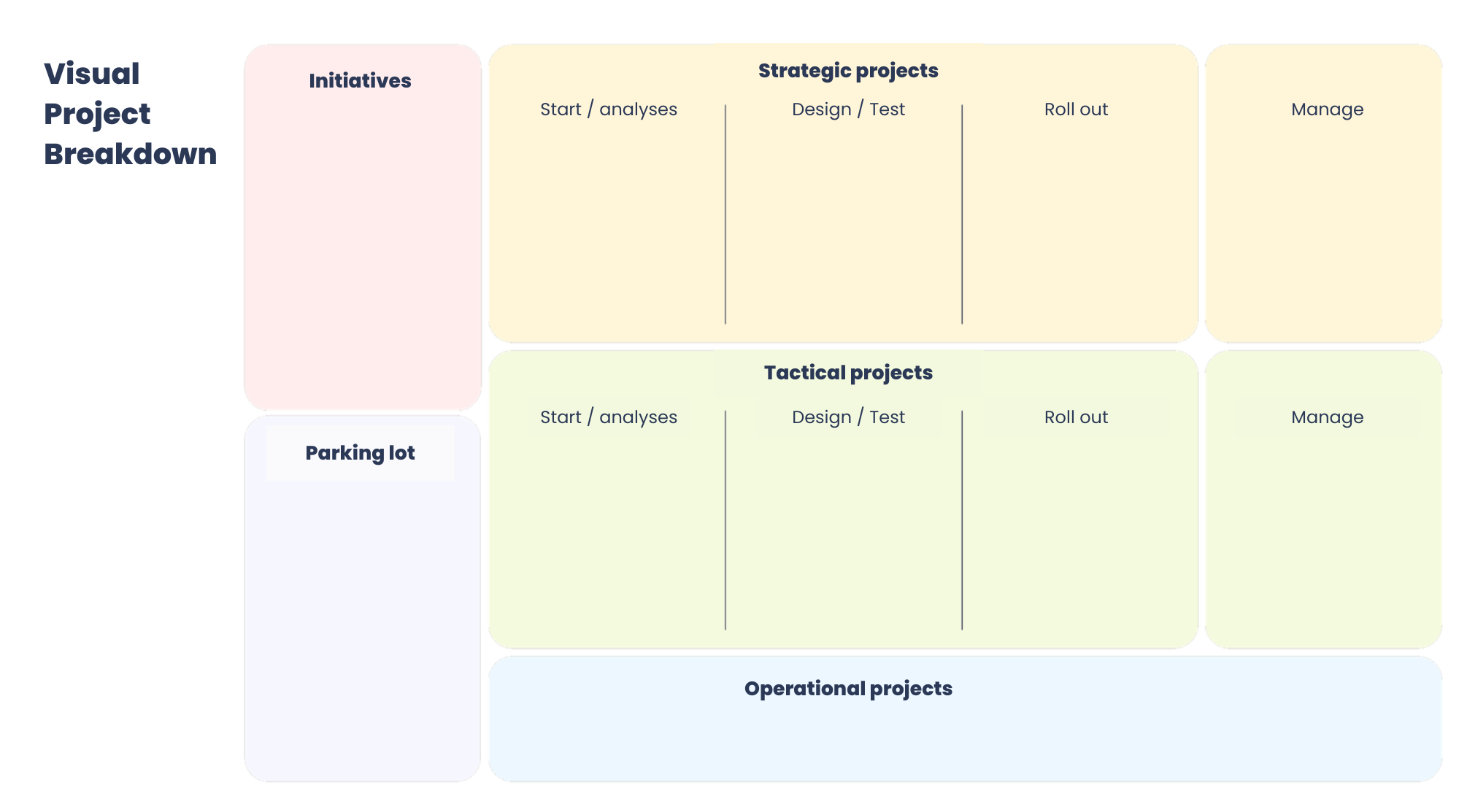
Every 6 months, the leadership team now revisits those priorities. They decide what to tackle, what to postpone, and what to park, keeping focus on what really matters and preventing the overload that had slowed them down in the past.
With the right priorities in place, the next step was to make sure they were actually feasible.
We started by looking where the real bottlenecks showed up in daily work. In organisations like WGK, these often surface first in local teams – the ones closest to patients and the reality of care. Their available time for project work is limited, and that’s okay. Recognising this helped everyone plan more realistically and maintain momentum without burning people out.
Instead of tracking every detail centrally, we focused on two golden rules for capacity checks:
By aligning priorities with actual capacity, projects now run at a sustainable pace — and expectations are clear from the start.
Finally, we established a rhythm of reflection and progress through recall sessions every 6 months.
These sessions are replacing long, ad-hoc evaluations with focused, structured conversations. Each cycle, the team looks back:
This routine creates the cadence the organisation had been missing. It gives leadership and local teams a shared moment to align, adjust, and celebrate progress.
What started as a long list of more than 60 projects has now become a focused, well-paced portfolio of 32 initiatives that truly deliver on the organisation’s strategy.
Teams across Wit-Gele Kruis now work with:
“What used to take us six days, now takes us a single, energised day. We’ve become faster, sharper, and more aligned.”
The organisation has found its pace: focused, clear, and ready to keep growing.
From the very start, it was about having the right conversations. We wanted to understand how Wit-Gele Kruis operates, what drives their people, and what already works well inside the organisation. Instead of analysing the organisation from a distance, we stepped into their world: Gunter spent a full day on the road with the nurses, seeing first-hand how they plan routes, handle unexpected situations, and support patients in their homes. Those insights shaped our understanding of how Wit-Gele Kruis operates, what drives their people, and where the real opportunities for corganisational change could be found.
From there, we started shaping things together and combining theory with practice. Trying out different methods, testing tools, and fine-tuning them until they felt like a natural fit for the team.
“They never came in to impose a new way of working, They looked at what we already had, refined it, trained us, helped us test it, and then encouraged us to take it further ourselves.”
We don’t believe in top-down consulting. Instead, we like to co-create. In Stefaan’s words:
“LQ made themselves almost redundant by empowering teams to continue independently”.
In the end, that balance between independence and partnership is exactly what we aim for: creating lasting change that lives within the organisation long after the initial programme has ended.
You already know where you want to go.
But as the Wit-Gele Kruis story shows, having a good strategy is no guarantee for success.
Real change happens when strategy is translated into focused decisions, achievable work, and alignment in the day-to-day.
If you’re ready to explore what that could look like in your organisation, our approach is a good place to start.
Because we know you haven’t come this far just to be good.
You’re here to go for gold.