
Picture this: it’s Tuesday morning and three AI requests are waiting in your inbox. One team wants Copilot licences. Another has been experimenting with ChatGPT and wants to scale up. A developer asks whether she can use an AI agent on client code. And somewhere in the organisation, a pilot is already running that nobody signed off on.
Every request sounds reasonable. And every request is urgent to someone. But how do you decide what to say yes to when there’s no shared direction to guide you?
In this article, Geert Letens, founding partner at LQ, shares how organisations can move from reacting to AI requests to taking charge: building a clear AI vision and strategy, making deliberate choices, and creating the conditions for people to actually adopt new ways of working.
Most organisations we talk to are already doing plenty with AI. People discover tools on their own, use them to do existing work faster and start experimenting within their own team or division. Some call this shadow AI: AI use that grows without formal approval or oversight.
It feels like progress. And often, it is. But activity alone doesn’t mean you’re moving in a deliberate direction. AI gets used wherever an opportunity happens to appear, without necessarily creating more value for customers or strengthening your proposition.
So what’s underneath this? In our experience, organisations often get stuck on the left side of four shifts:
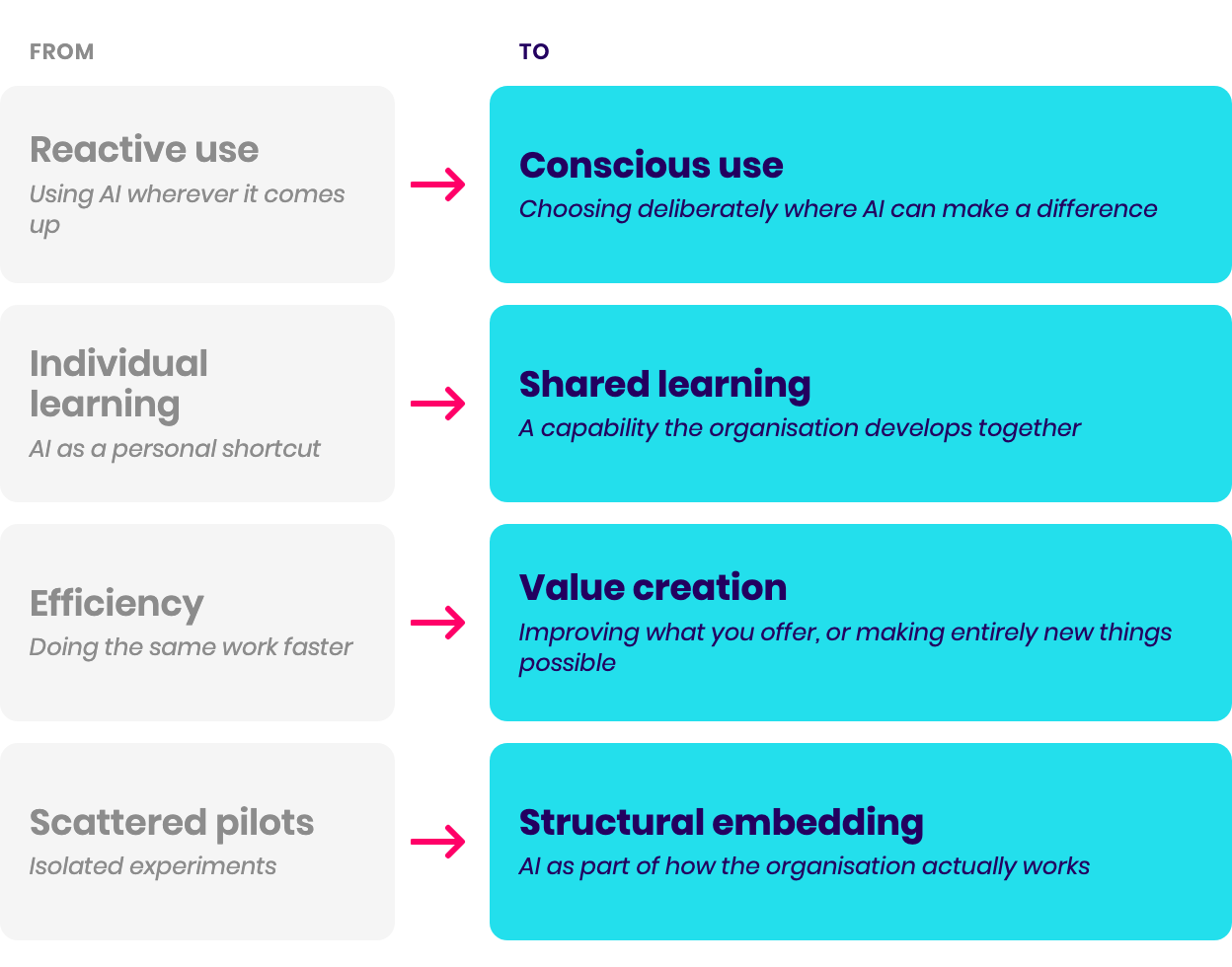
Making those shifts starts with direction. Before you can decide which tools, pilots or opportunities deserve your attention, you need a shared view of where AI can create value for your organisation.
You need a compass.
“There’s no shortage of signals,” Geert says. “What’s missing is a compass: an AI strategy that aligns with your business strategy.” This way, individual requests become easier to assess: does this opportunity support where we want to go, or doesn’t it? “Instead of reacting ad hoc, you have a compass: it should go in this direction, because that’s where we see the most potential for our business.”
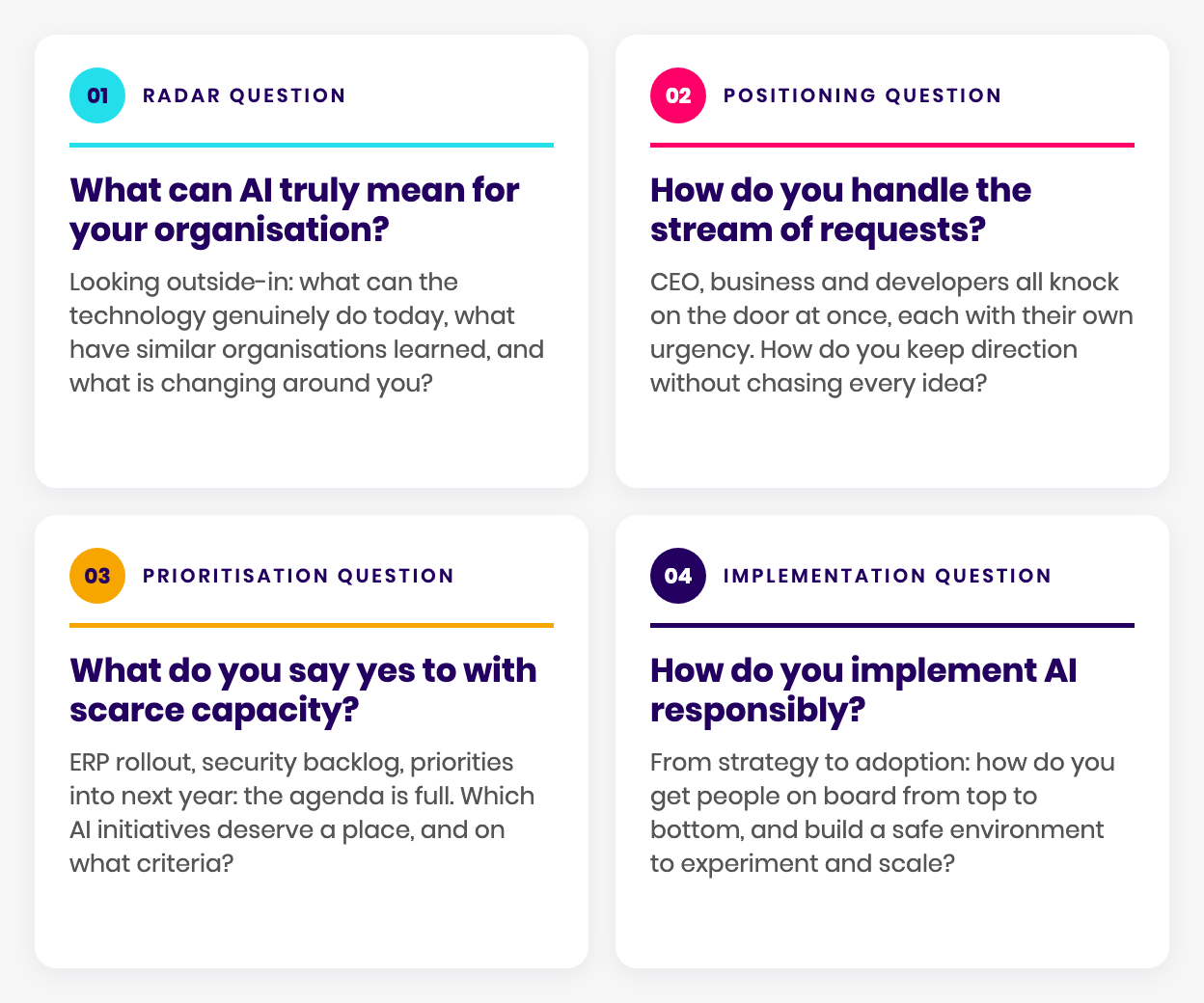
The first question your compass needs to answer is: what can AI truly mean for your organisation?
Strategy is about making choices: where to play, and how to win. Where to play means deciding who your customers truly are and who they are not, as well as what products or services to focus on. Playing to win implies that you decide on your winning value propositions (price, product, service, connectivity or access) and tune your operating model to this context.
The same questions are key in formulating your AI strategy as well.
→ Start by looking outside-in. What can the technology genuinely do today, and what is still more promise than proven practice? What have organisations with similar processes already learned? And what is changing around you, from new regulation related to AI to the economic pressure it is creating?
→ Then bring that outside perspective back to your own organisation. Where could AI make the biggest difference in the processes that matter most, both internally and for your customers?
These reflections are essential to make sure that your compass points in two directions: inwards and outwards. It can be tempting to start with internal applications, because they feel easier to control. But AI is already changing how customers find you, choose you and buy from you.
Looking only inside your organisation means missing half the picture. “I certainly wouldn’t split internal and external,” Geert says. “You’d simply be losing time.”
The answers will look truly different for a hospital than for a logistics company. And that’s exactly the point. Your AI compass should reflect where your organisation wants to create value and stand out.
In terms of ambition, bigger isn’t always better. Your ambition has to match what your organisation can actually support. Do you have the right expertise? Is your data ready? Can you assess how reliable the output is? And do you have the capacity to build, fund and support these initiatives?
Those capabilities need to grow alongside your ambition. That’s what turns an AI compass from a vision into a practical guide: It helps you focus on the opportunities with the most potential, while being realistic about what your organisation can support today.
Besides capabilities, there’s the question of capacity. In most organisations we work with, IT already has more than enough on its plate: an ERP rollout, a security backlog, priorities stretching well into next year. AI doesn’t replace any of that. It lands on top of it.
Our Six Batteries research points to the same challenge: one of the biggest energy drainers in organisations is simply trying to do too much at once.
So having a compass also means making deliberate choices within the people, time and budget you actually have. What deserves priority now? And just as importantly: what doesn’t?
Making those choices explicit changes the conversation. People understand why one request gets a yes, while another has to wait.
There’s another important difference to keep in mind: an AI transformation doesn’t follow the same programme logic most organisations are used to.
“With an ERP rollout, failure is simply not an option,” Geert says. “An AI programme is all about experimenting. The learning effect has to come first, ahead of trying to look good.”
"With an ERP rollout, failure is simply not an option. An AI programme is all about experimenting. The learning effect has to come first, ahead of trying to look good."
A traditional programme might still map out the next two or three years and measure success against that plan. AI requires a different rhythm. You still need a clear direction, but you don’t need to have every step figured out from day one.
Start with a scope your organisation can carry today. Build, evaluate and scale in iterations of roughly 3 to 6 months. After each round, ask: what have we learned about the opportunities and capabilities, and what does that mean for the next wave?
Some experiments won’t survive that evaluation, and that’s the design doing its job. What looked promising at the start may turn out to be too early, too complex or too ambitious for what your organisation can support right now. That’s the learning process at work, and it beats discovering the same thing three years into a master plan.
This does require a different mindset. A project has an end date. AI doesn’t. “AI is something you position as a core capability in your future organisation,” Geert says. You build this capability one iteration at a time.
And that’s where the conversation moves beyond technology.
Technology is often the easy part. The hard part is getting the organisation around it to move. BCG estimates that around 70% of AI project failures come down to people and process. In other words: a strong AI strategy means little if people don’t understand it, support it or change the way they work.
That’s why we look at AI transformation through the Six Batteries of Change, our evidence-based approach to transformation. The principle is simple: sustainable change requires both the rational and the emotional side of the organisation to move together.
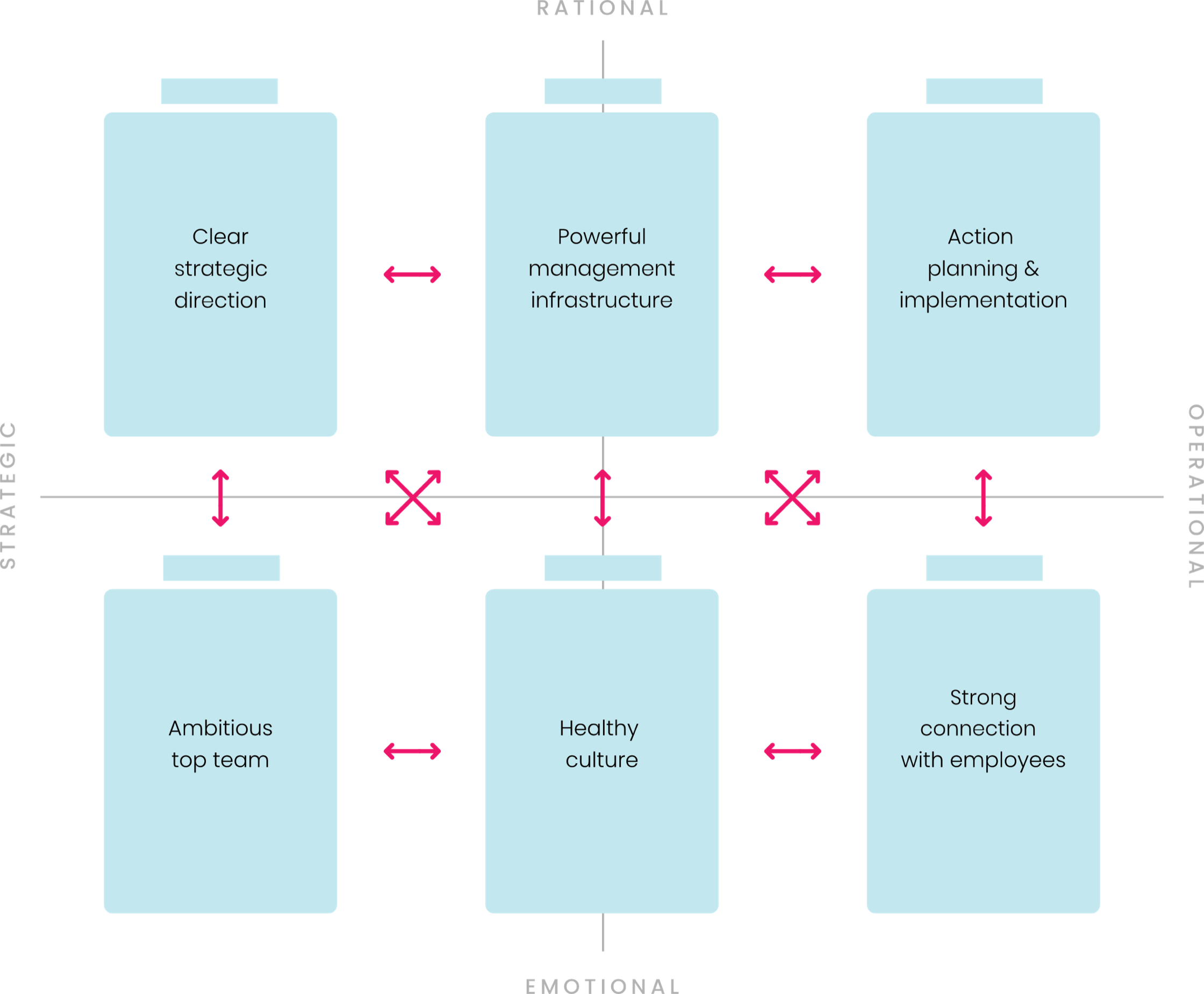
The compass work we’ve described so far mainly strengthens the rational side. You need a clear strategic direction: where can AI strengthen your competitive position? You need a strong management infrastructure: budgets, KPIs and decision rights built into the rhythm of the organisation. And you need action planning that turns promising pilots into programmes with clear owners.
But that is only half the work. The emotional side is just as important.
Taking AI beyond the pilot phase and into the wider organisation calls for a different mindset, from the people who use it every day and the leaders who guide them. That’s what the emotional batteries are about.
A Healthy Culture gives people the safety to experiment, get things wrong and share what they learn. The iterative rhythm we described above depends on it. Short learning cycles only work when people can openly discuss what went wrong.
Building that mindset starts with helping people feel comfortable using AI. AI ambassadors can play an important role: colleagues who work with AI hands-on within their own function.
We recommend building a network of ambassadors across the organisation, well beyond IT. Bring them together regularly to exchange experiences, share what works and learn from one another. They can then take those insights and that enthusiasm back to their teams, helping AI adoption spread across the organisation.
People take their cue from the top. Culture only holds if the top team carries it.
An Ambitious Top Team doesn’t just sponsor AI from a distance; leaders visibly use it themselves. In our experience, few things are more powerful for adoption than leaders going first.
That also means being open about the learning curve. When leaders show that they are learning too, they make it easier for others to experiment, ask questions and get things wrong along the way. At the same time, they help the organisation decide which experiments deserve room to grow and which can wait.
As AI adoption grows, the top team also needs to stay close to what it means for people’s roles and day-to-day work. This brings us to the third emotional battery.
Even with the right leadership and culture in place, AI brings tensions that people don’t always say out loud.
A leader recently put it to us like this: “We keep saying AI is about doing better work. But everyone in the room knows it’s also about doing it with fewer people. And nobody wants to say that out loud.”
The effects are undeniable. When concerns stay under the surface, they can create resistance long before a new tool reaches people’s day-to-day work.
There are four human forces at play:
“The doom scenario of ‘AI will take my job’ is something you want to be able to discuss early,” Geert says. Put that conversation on the table before the tooling arrives. Redesign the work together with the people who actually do it, and create space for fears, questions and expectations to be voiced.
"The doom scenario of 'AI will take my job' is something you want to be able to discuss early."
That also means being clear about what stays human. Using AI well takes skills AI doesn’t replace: judgment, creative thinking, analytical thinking and the ability to adapt.
The World Economic Forum ranks analytical and creative thinking among the skills employers will need most towards 2030.
Some organisations are already investing accordingly. EY is setting aside $100 million for bonuses tied to skills such as adaptability, judgment and innovation. You don’t need a bonus programme to make the same point: show people which human skills matter more with AI, and invest in them.
The first step is smaller than the full picture might suggest. You don’t need a complete AI strategy before you can start moving. A first orientation, from the outside landscape to your own opportunities, choices and priorities, can be done in a matter of weeks.
From there, you experiment, evaluate and scale. Each iteration gives you a better view of both where AI can create value and what your organisation needs to deliver on this potential.
And involve your people from the start. Don’t wait until the tools are selected or the first pilots are ready to scale. Bring employees into the conversation early, let them help shape how work changes, and make space for the questions and tensions that come with it.
Because a strong AI compass gives you direction. But it’s the organisation around it that determines whether you actually get there.
Want to see what that looks like in practice? On Friday 25 September, Geert is hosting a live webinar on building an AI strategy your organisation truly adopts: save your seat.