
Re-set strategic direction, future backward.
When senior leadership is mobilised to move on the NOW FOR NXT journey, it is important to capture the energy that is released and point it in the right direction, which means adjusting or even resetting the company strategy. This is a critical step, which requires a different approach from traditional strategic business planning.
Different, how? Quite often, whether deliberately or not, companies that are strategizing take their current situation as a starting point, look at different data points and then think where they would like to be in about five years from now. However, if you truly want to move the needle, you will only be able to get to the right strategic answers when you spend substantial time envisioning the end game first, looking minimally 10–20 years ahead and only then starting to reason backwards. This calls for more visionary thinking.
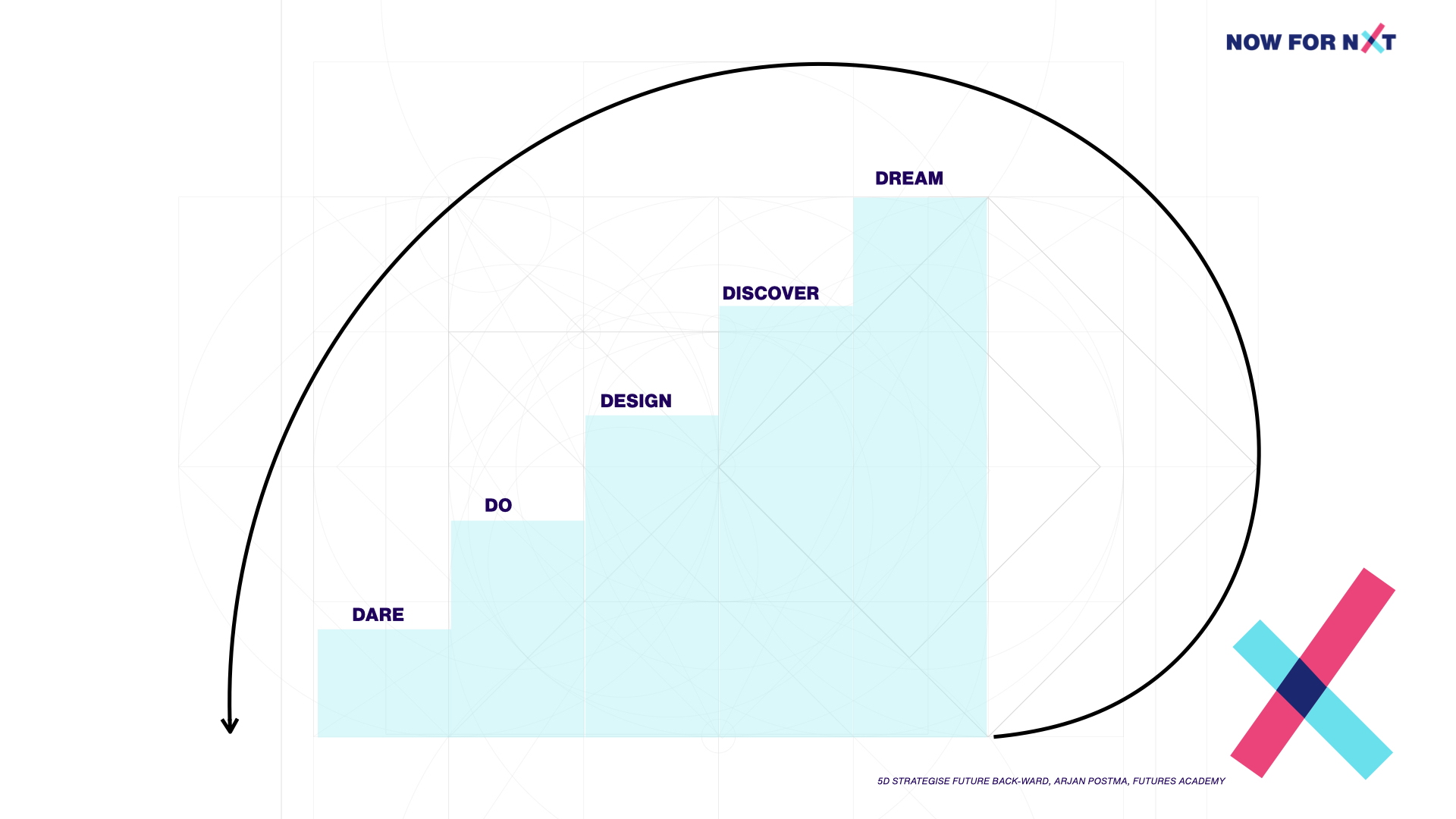
Visualise the End Game: Given that the NOW FOR NXT journey, requires systemic change, together with the executive leadership team and selected individuals in the next layers, we create images of what the landscape will evolve into and what this implies for how the business could grow its impact, taking into account trends and scenarios. We think long term here and reason from the dream backwards, tapping into the know-how of people within the organisation, customers, stakeholders and industry experts. No decision-making happens at this stage. The end-state and the way to get there is visualised by our visual artists.
Develop the narrative: Next we work with the CEO and the leadership team members to turn the landscape painted and opportunities explored into a first version of the narrative. In this narrative inconvenient truths about the business today including its CO2 emissions or negative biodiversity impact are made explicit, to not shy away from the discomfort with the current reality. Simultaneously, comfortable truths are highlighted.
This narrative is written by the CEO, while leadership team members support this process by writing their individual one-pagers in parallel, without seeing each other’s. These stories are then used to pull the first version of the narrative together. Key ingredients of the narrative are answers to questions like: “Where have we come from & where are we now?”, “Why can’t we continue the way we are?”, “What is our north star and how do we get there?”, and “What would great look like?”
“Where have we come from & where are we now?”, “Why can’t we continue the way we are?”, “What is our north star and how do we get there?”, and “What would great look like?”
Get the right data on the table: The narrative guides what data to gather, what hypotheses to validate and what sprints to run, to further develop and build a bulletproof business strategy. Input from (non)customers, as well as industry experts, is needed to validate assumptions. The importance of the double materiality assessment as a key document cannot be underestimated.
Adjust the value driver tree: To be sure that the vision translates into true future value, the value drivers and KPIs used in the company normally need to be updated, which we recommend making a start on in this phase. This is because many companies have not properly incorporated the concept of a Value Tree into their financial steering yet, and are typically still using old paradigm financial value trees, which ignore material costs and benefits related to for example carbon emissions, (non-)circularity, brand-reputation & risk and their impact on the company’s multiplier. To be able to measure true future value these drivers need to be incorporated.
Strategise backwards: When a clear picture of the end game is painted, including the company true value and impact generated, backed up by facts, it is time to work our way backwards, with more mainstream strategy formulation and planning activities. This means that, in co-creation with the leaders, we operationalise this vision and formulate how to play to win in each horizon. We jointly identify the key strategic steps to take and battles to win internally and externally. After the strategic direction is plotted on the horizons, we crystallise how to put the strategy into action, by running concept design sessions on the heart of the strategic drivers, with cross-functional teams, resulting in a clearer view of how to play to win in action. Finally we work side by side until all strategy streams have clear owners and timelines and are well planned and resourced. This process typically takes about 3 to 4 months. On the left page we illustrate what this process could looks like.
NOW FOR NXT has developed an innovative approach to organizational development through monthly Design workshops that are revolutionizing how Stolt Tankers approaches innovation, problem-solving, and future readiness. These intensive sessions are custom designed to empower over 200 managers with crucial future skills, focusing on Design Thinking and Future Readiness.
The sessions are distinguished by their highly pragmatic and hands-on approach. The core philosophy is simple yet powerful: participants bring real organizational challenges, and these are comprehensively addressed within a 24-hour timeframe. This immediate, practical problem-solving methodology ensures that learning is not theoretical but directly applicable to the organization’s immediate needs. In addition participants will all start to do 2–3 change experiments with their teams. To create internal impact and scale, preparing the organization for more change readiness we trigger 200 participants × 3 experiments × 10 team-members is 6000 new initiatives.
By investing in these Design workshops, Stolt Tankers is not merely training managers but fundamentally reimagining its organizational capabilities.
The workshops introduce a transformative language that:
Complementing the live workshops, an online module provides weekly inspiration through global case studies. These showcases feature pioneering organizations that have successfully driven innovation and expand participants’ perspectives on potential organizational transformations.
NOW FOR NXT’s Design workshops represent a strategic intervention that transforms individual managers into catalysts of organizational innovation. By combining practical problem-solving, cutting-edge methodologies, and continuous digital learning, the program positions Stolt Tankers at the forefront of future-ready organizations. The case demonstrates how targeted, experiential learning can create lasting organizational transformation, making innovation not just a strategy, but a fundamental organizational capability.
Here comes step 5 →