
Go for relentless execution with two engines.
Let’s take stock for a minute. By this point, senior leaders are aware of and wholeheartedly believe in the direction which drives true value and makes the company future-ready. This is not a bad position to be in, but it is often the point where we see clients take their foot off the pedal, whereas at least as much gas is required as on the initial part of the journey. Plus, as this is an iterative journey, bright spots in this area can be built at any point in time, even if there is still work ongoing to get the other ingredients in place.
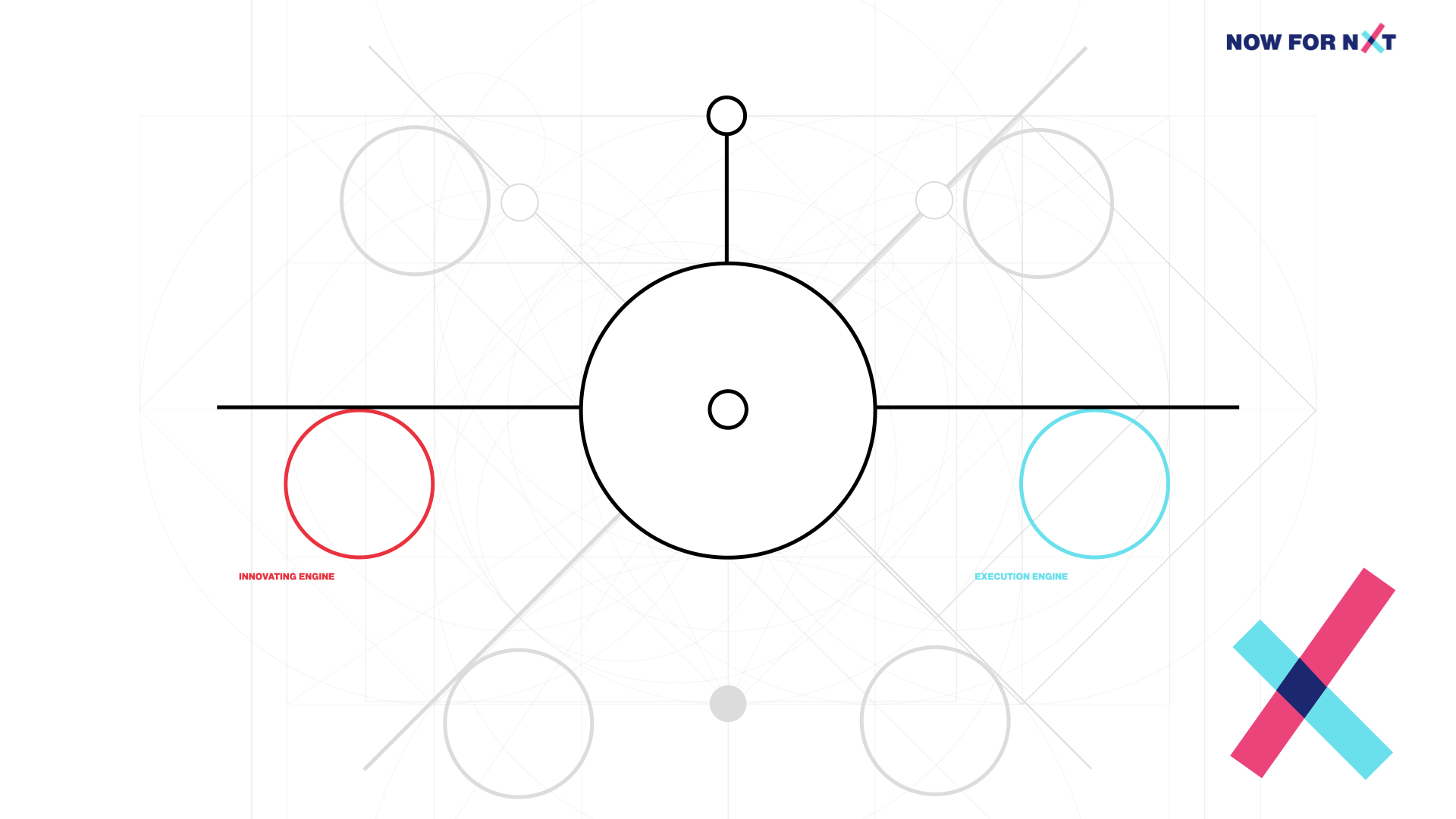
Given that human-centric design, ecological stewardship and biodiversity related challenges typically do not have an answer yet, they will ask for creation of the unknown, to implement the business strategy. Relentless execution of the business strategy is therefore a balancing act, to simultaneously earn your profits with the day to day activities, and use these means to invent and fund the future direction. To balance this perform and transform agenda, this requires both an Execution Engine and an Innovating Engine to fly, as illustrated by the picture on the next page, created by Ben Bensaou.
The Execution Engine is all about delivering on today’s strategy and solving all the problems which come with that. The Innovating Engine is all about running a funnel with a targeted set of strategic experiments together with the ecosystem, to build the next version of the company, delivering on tomorrow’s strategy.
1. Stop to Start – There is often a quick win to implement first, which is the proactive stopping/slowing down/phasing out of meetings, projects or initiatives, which is possible with the renewed level of clarity of the business strategy. By organising simple, two-hour ‘stop to start meetings’ across the full organisation, you encourage everyone to gain a minimum of 3–10% time before anything is added. Simple initiatives like changing standard meetings from 60 minutes to 45 minutes can free up time very easily.
2. Horizontal and vertical KPI alignment – To be able to rigorously execute on the business strategy, and ensure everyone in the company understands how they can contribute to the balancing act of both performing now, and transforming to what is next, it typically helps to translate the company dashboard into three types of KPIs for all:
Type 1 KPIs, the bread and butter of your job, part of the existing execution engine, on which 70% of the time is typically spend.
Type 2 KPIs, which are all about continuous improvement of your job, also being part of the existing execution engine, on which 20% of the time is typically spend.
Type 3 KPIs, the innovation kpIs, which cause disruption in your job, being part of the Innovating Engine, on which 10% of the time is typically spent.
The kPis related to the Execution Engine, deserve a P in capital letter, as it is about actual results, performance, and efficiency in executing. The kpIs related to the Innovating Engine, deserve an I in capital letter as they are indicating the innovation activities, funnel progress, investment allocation and scaling performance.
Ensure you’ll do the KPI definition and implementation work with staff in an engaging manner, for example through 5-minute-pitches, in which each individual shares one’s own KPIs on one page, and pitches this to colleagues, after which the team works on horizontal and vertical alignment together. In this way KPIs become truly known, understood and owned by and across individuals and teams.
3. 21st-century mindset, skillset & toolset embedding – Finally, to be able to run the Innovating Engine activities, you need to invest in the ability of all employees to bring the mindset, toolset and skillset to contribute. The Futures Academy is well equipped to support this educational process with top-notch online and offline 21st-century training including cases, tooling and instruction videos on matters like the basics of sustainability, AI, growth thinking, design thinking, creating partnerships and running experiments. Those will empower employees at all layers in the organisation to contribute.
Ready for the last step? →