
Make your organisation fit for your ambition
A CEO once told us, half-laughing, half-tired: “We used to make decisions in the corridor. Now we need a calendar invitation, a steering group, and a follow‑up meeting to decide on the follow‑up meeting.”
Growth often brings hidden cost: more layers, more handovers, more meetings. Decisions take longer because more people need to weigh in. Work gets duplicated because ownership isn’t clear.
Collaboration stops being a lever for speed and becomes a tax on time and focus.
At LQ, we help you shape an organisation that supports your ambition in real life: clear enough to move fast, strong enough to scale, and human enough to bring people with you.
We’re usually asked to help when leaders recognise that something is no longer working, but it’s hard to put a finger on where to start.
Typical signals:
And often there’s a deeper tension underneath:
“We want to work more together, but we don’t want to lose autonomy, speed or ownership.”
For us, organisational development is not a theoretical exercise. It’s deeply practical.
We work on the concrete elements that determine whether strategy turns into action:
Always in service of one question:
Does the way you are organised help people do the work that matters most?
We’re also explicit about what organisational development is not.
There is no perfect design that makes everything easy. Organisations are living systems. What we aim for is not perfection, but a setup that makes the desired outcomes more likely.
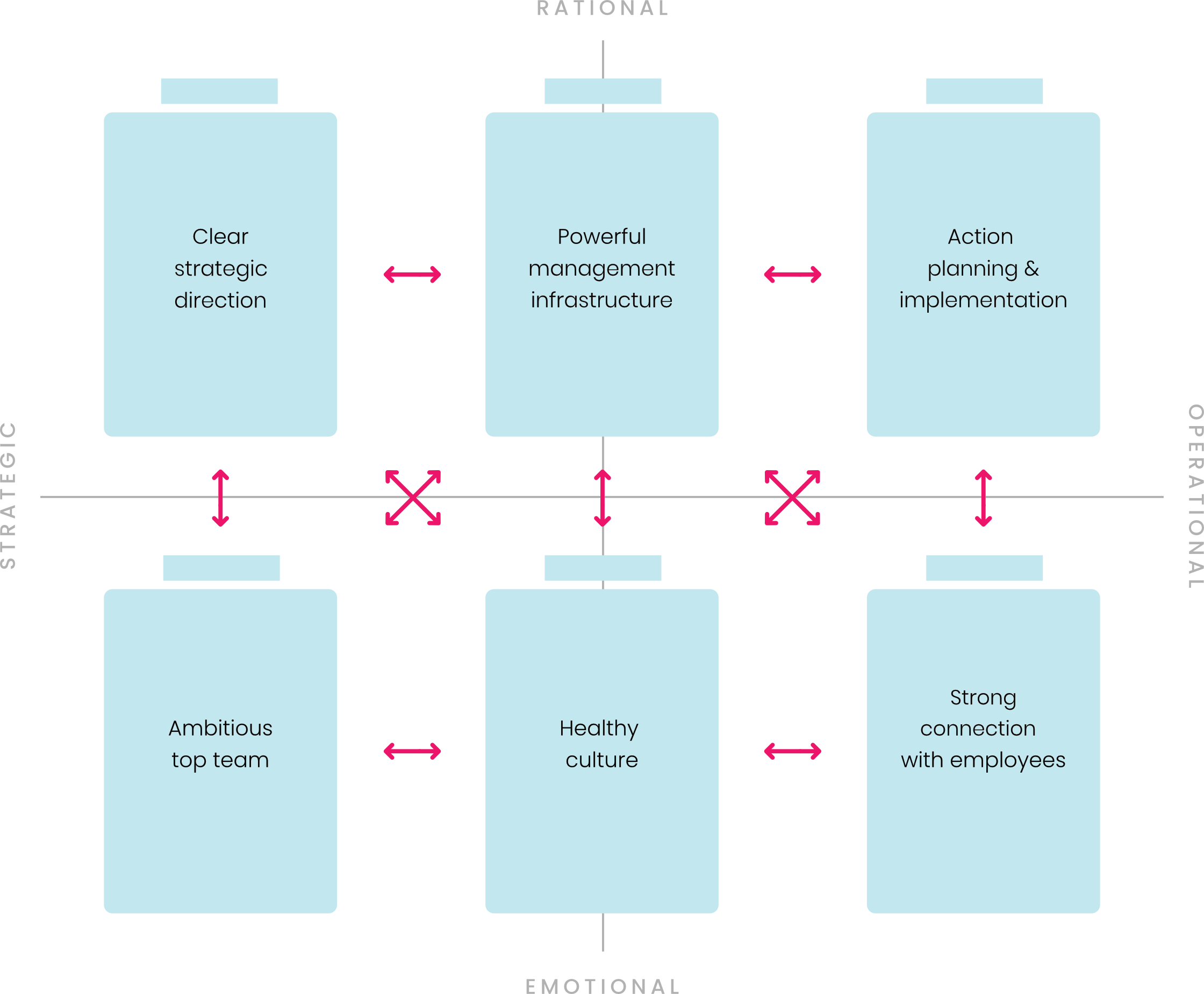
That’s why our work connects most strongly to 2 of our Six Batteries of Change:
Together, these 2 batteries are what translate strategy into day-to-day decisions and behaviour.
Organisational change touches identity, pride and meaning. People want to know that their work, and their expertise, matters.
When change feels ‘done to them’, resistance is a natural response.
That’s why we work with Fair Process Leadership: a proven approach developed at INSEAD.
In practice, this means we consistently do three things:
Before designing solutions, we involve people in clarifying the question:
What are we actually trying to solve?
This alone often brings relief and clarity. Many frustrations turn out to have shared roots.
Restructuring may be part of the answer, but it’s rarely the only lever.
Together, we explore alternatives such as leadership practices, prioritisation, strategy clarity, meeting rhythms or behavioural agreements.
Only then do we decide what combination will truly help the organisation move forward.
We make decision-making explicit.
That means: the people who carry the accountability also carry the decision.
We agree things like:
We start broad, involving a representative group from each discipline across the organisation to build shared understanding.
We then work with a focused design team, drawn from the organisation itself, to develop the future design and governance.
And throughout, we always work face to face. Trust, alignment and ownership are built together, not in a slide deck.

When structure, governance and ways of working align, decisions speed up, collaboration improves, and work starts to flow again.
What leaders typically notice first is simple: less friction, more delivery.
And perhaps most importantly: renewed confidence that the organisation is working with its people.
"If your organisation no longer flows, because growth has added complexity and collaboration isn't delivering, that's exactly the moment to redesign how you're organised. We've done this before, and we know how to make it land."
There’s usually a moment when leaders realise: we can’t keep adding meetings and layers to solve today’s challenges.
It might be time to talk if:
Sounds familiar?
Let’s have a conversation. We’ll help you get clear on what’s really going on, and what would make the biggest difference next.